

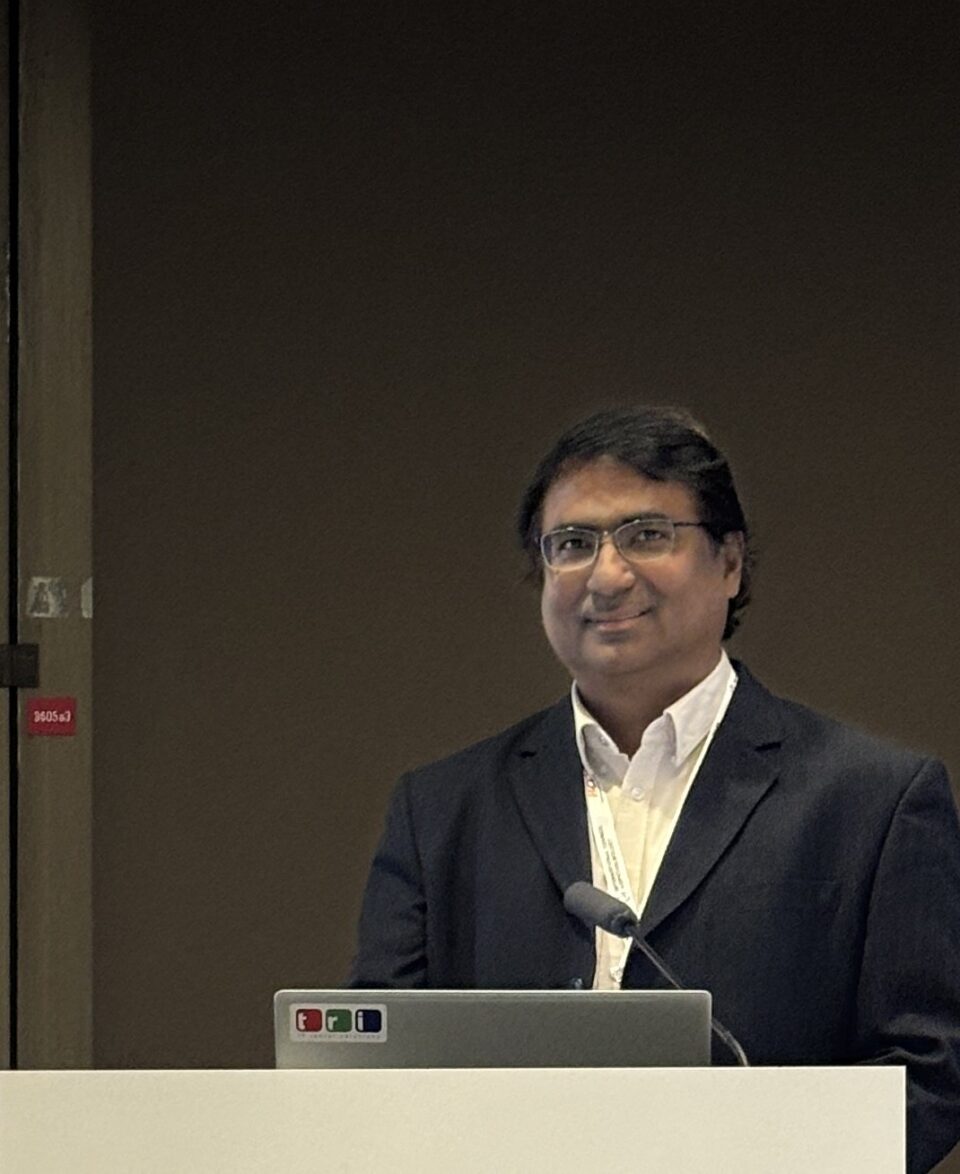
In an interview with Venkatakrishnan S, Chief Technology Officer and Head of R&D at Forus Health, we explore how Oculomics is transforming retinal imaging into a powerful tool for identifying potential signs of systemic health conditions. He discusses the role of AI in detecting subtle retinal biomarkers, the potential of Oculomics to enable early diagnosis of diabetes, cardiovascular and neurological disorders, and how this emerging field could strengthen India’s shift towards predictive and preventive healthcare.
1. How is Forus Health using Oculomics to transform the retina from an organ primarily associated with eye health into a source of insights for detecting broader systemic health conditions?
Oculomics is rapidly emerging as a technological breakthrough in preventive care. The eye is a unique organ that allows a direct, non-invasive visualization of neural and vascular tissue through high-resolution imaging devices like Fundus Cameras and OCT (Optical Coherence Tomography). The vessels and tissues in the eye show changes in one’s body long before any bodily symptoms are seen. By integrating AI models with specialized algorithms in our high-definition imaging devices, AI models can evaluate changes in structural parameters like vessel tortuosity, transforming these dynamic images into actionable intelligence enabling detection of systemic health conditions.
By integrating advanced AI with portable, high-performing imaging devices, we are empowering clinicians to deliver precise diagnostic screening with optimized clinical workflows to individuals worldwide.
2. What are the most promising retinal biomarkers that Forus Health is currently exploring, and how could they enable earlier detection of conditions such as diabetes, cardiovascular or neurological disorders?
Some of the most promising retinal biomarkers that are helpful for detection of conditions like diabetes, CVD and neuro disorders are related to retinal arteries and venules like Branching coefficient, Junction exponent, Mean artery/vein width, Optimality ratio, Path length, Simple tortuosity, Vessel diameter reduction and few common biomarkers between arteries and veins like CRAE(Central Retinal Arteriolar Equivalent) and CRVE (Central Retinal Venular Equivalent), Arteriovenous ratio, Fractal Dimension. These biomarkers help to identify healthy subject from a subject at risk of these conditions.
3. How is AI helping Forus Health analyse retinal images at a level that can identify subtle biomarkers, and what clinical validation is required before these insights can be translated into routine healthcare?
With the rise of deep learning architectures specifically Convolutional Neural Networks (CNN) and more recently Vision Transformers (ViTs), AI has revolutionized the way we screen and analyze the reports. The modern deep learning frameworks integrated in our devices power critical functions across the screening pipeline like Automated Image Quality Validation, Automatically segmenting lesions , microneuryms, hard/soft drusen down to pixel level , also enabling classifying pathology severity against recognized international diagnostic standards. AI models evaluate structural parameters such as vessel tortuosity, AV nicking, caliber asymmetry and fractal dimensions as surrogate markers for systemic health indicators.
Clinical validation involves validating biomarkers and its relevance for various clinical conditions subjects against the existing gold standards like blood, urine tests and even CT imaging based diagnosis for some conditions.
4. Could Oculomics make preventive health screening more accessible by enabling multiple health risks to be assessed through a single, non-invasive retinal imaging process, particularly in underserved regions?
Oculomics, by itself, does not make preventive health screening more accessible. It is the science of studying the eye and extracting clinically relevant insights using AI. To translate these insights into faster and more accessible screening, Oculomics needs to work alongside advanced imaging technologies and secure cloud infrastructure.
Portable imaging devices make it possible to capture high-quality retinal images closer to the patient, including in underserved and remote settings. When these devices are integrated with AI models, they can support faster assessment and help streamline clinical workflows for doctors. Secure cloud connectivity then enables images and AI-assisted insights to be shared remotely with specialists, making screening and expert consultation possible even where specialist access is limited.
The real opportunity, therefore, lies not in Oculomics working in isolation, but in bringing together portable imaging, AI-powered analysis and secure connectivity to make eye and preventive health screening more efficient and scalable.
5. As Oculomics evolves, what could be its larger role in India’s shift from reactive treatment towards predictive and preventive healthcare?
The cost of late stage diagnosis and treatment is ever increasing and becoming a huge burden to all, especially the poor, lower middle class population. Only way to handle this situation in the long term is to focus on prevention and predictive health assessment measures that prevents people from getting to serious health conditions. That is where Oculomics can play a big part. A simple noninvasive imaging of retina can identify biomarkers that pick up subtle signs of vascular and neuro degeneration very early on before it can be picked up by human eyes or existing gold standards like blood tests. This can help very much in detecting serious health conditions much early and preventing the deterioration of health into a serious health condition. Oculomics can be deployed in all primary health centers and screened as a preventive measure and referred to a tertiary center for any serious conditions. As saying goes, “Prevention is any day better than cure” and no technology is better equipped to drive this than Oculomics.
